

Canton POS

Outside the Lines: Abstract Art from the CMA Collection (November 24, 2026 - March 7, 2027)

Abstract art is a broad and dynamic category of artistic expression that departs from realistic representation. Rather than depicting recognizable objects, figures, or landscapes, abstract artists use color, shape, and line as the primary imagery. This approach allows the artwork to communicate emotion, movement, or conceptual ideas without relying on literal imagery. Emerging in the early 20th century alongside major cultural and technological shifts, abstraction challenged long-standing expectations of what art should look like and how it should function.
At its core, abstract art invites interpretation. Because it does not prescribe to a single, fixed meaning, viewers are encouraged to engage more personally with the work — responding to rhythm, contrast, or atmosphere in ways that are often intuitive rather than analytical. Some artists use abstraction to explore spiritual or philosophical themes, while others focus on formal experimentation or the physical act of making. The result is a diverse field that ranges from highly structured geometric compositions to spontaneous, gestural works, all unified by a shared emphasis on visual language over direct representation.
-
Abstract art doesn’t have to “look like” anything—its whole point is to move beyond realistic representation.
-
It really took off in the early 1900s, when artists started questioning tradition and experimenting more boldly.
-
Abstract art can be emotional, spiritual, political, or purely visual—it doesn’t follow one set meaning.
-
There’s no “right” way to interpret it—your reaction is part of the artwork’s meaning.
-
Many abstract artists were influenced by music, philosophy, and even science. Some artists even believed that colors could express sound and emotion like music.
-
It includes a wide range of styles, from bold color fields to minimalist black-and-white compositions.
-
Some people love it, some people don’t—but it almost always sparks a reaction, which is kind of the point.
Drawn from the Canton Museum of Art’s permanent collection, Outside the Lines brings together abstract works that use color, shape, gesture, and material to express ideas and emotions beyond recognizable images. Each artwork encourages close looking, personal interpretation and emotional response in a big way — many of the works are large-scale, emphasizing the immersiveness of the experience.
By stepping outside traditional expectations of what art should depict, Outside the Lines offers an open, welcoming way to engage with abstraction and discover how art can communicate through feeling as much as form.
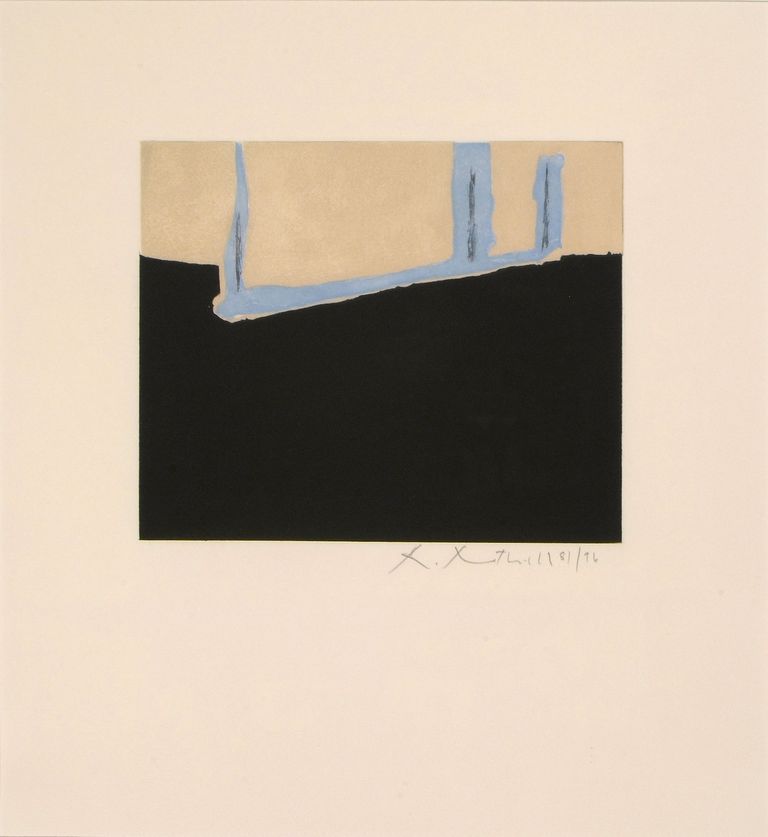
Pictured top to bottom:
Mariafel, 1972. Greg Rossi (Ib. 1947). Acrylic on canvas, 88 x 124 in.
Untitled, 1975. Robert Motherwell (1915-1991). Aquatint on paper, 10 x 12 in.